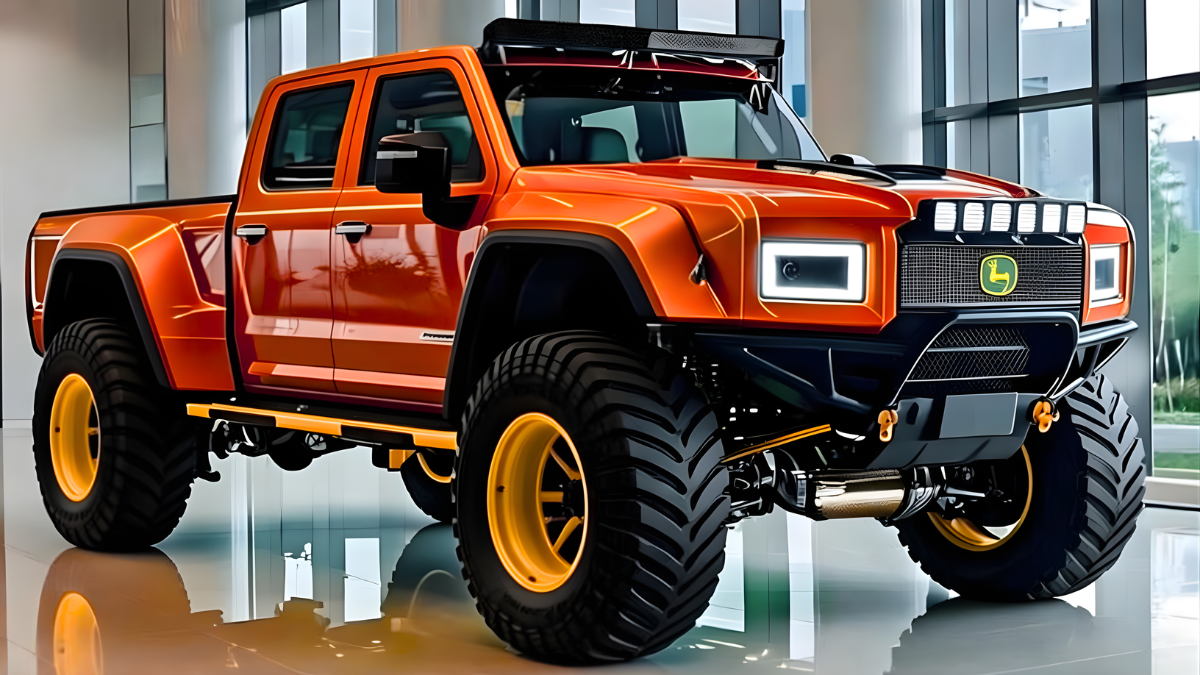
The 2026 John Deere Pickup Truck concept has quickly become one of the most talked-about future truck ideas, not because it has been officially confirmed, but because it feels believable, powerful, and perfectly aligned with what modern buyers want from a work-focused pickup. Known globally for building some of the toughest agricultural and construction machinery, John Deere represents durability, reliability, and engineering built to survive extreme conditions. Translating that legacy into a pickup truck creates a vision that instantly resonates with farmers, contractors, and off-road enthusiasts.
This concept imagines what happens when industrial toughness meets modern digital intelligence. Instead of chasing luxury trends, the 2026 John Deere Pickup focuses on strength, functionality, and smart technology that actually supports work, hauling, and real-world use.
Rugged Exterior Design Rooted in Industrial Heritage
The exterior design of the 2026 John Deere Pickup Truck concept reflects the brand’s heavy-equipment DNA. The body is squared-off, muscular, and purposeful, avoiding soft curves in favor of straight lines and solid surfaces that communicate toughness. A bold, industrial-style front grille dominates the fascia, inspired by John Deere tractors and construction machines.
Signature green paint with yellow accent detailing instantly identifies the truck’s heritage. Reinforced steel bumpers, visible tow hooks, skid plates, and protective cladding suggest a pickup designed to take abuse without complaint. High ground clearance and wide fender arches accommodate large all-terrain tires, reinforcing its off-road and work-site readiness.
LED lighting elements add a modern touch while improving visibility in low-light work environments, fields, and trails. Overall, the exterior feels less like a lifestyle truck and more like a serious tool built for demanding tasks.

Interior Built for Work With Smart Comfort
Inside the 2026 John Deere Pickup Truck, the focus shifts to practicality combined with modern convenience. The cabin design favors durability first, using hard-wearing materials, reinforced surfaces, and easy-to-clean finishes suitable for muddy boots and long workdays.
Seating is upright and supportive, designed to reduce fatigue during extended driving hours. Controls are large, tactile, and logically placed, ensuring they can be operated easily even while wearing gloves. This industrial approach mirrors the design philosophy of John Deere machinery cabins.
At the same time, digital innovation plays a key role. A large central touchscreen serves as the command center for navigation, vehicle settings, and connectivity. Smartphone integration, digital gauges, and multiple USB ports support modern workflows, whether managing a job site or coordinating logistics on the move.
Digital Innovation and Smart Connectivity
What truly sets the 2026 John Deere Pickup concept apart is its emphasis on intelligent technology rather than luxury gimmicks. The truck is imagined as a connected work platform, capable of real-time diagnostics, vehicle health monitoring, and predictive maintenance alerts.
Cloud-based systems could track engine performance, suspension load, and service intervals, helping owners prevent downtime before problems occur. For agricultural and construction users, deeper integration with digital ecosystems could allow the pickup to sync with equipment data, maps, and job schedules.

This digital focus aligns perfectly with John Deere’s leadership in precision agriculture and smart machinery, making the pickup feel like a natural extension of the brand rather than a novelty.
Powertrain Expectations Focused on Torque and Efficiency
While no official specifications exist, most interpretations of the 2026 John Deere Pickup Truck imagine powertrains designed around torque, reliability, and efficiency. A turbo-diesel engine is widely expected in concept discussions, offering strong low-end pulling power for towing trailers, equipment, and heavy loads.
Hybrid possibilities are also frequently mentioned, pairing a combustion engine with electric assistance to improve fuel efficiency and deliver instant torque at low speeds. This approach would make sense for a work truck that needs power without excessive fuel consumption.
Advanced four-wheel-drive systems are assumed to be standard or widely available, ensuring the pickup performs confidently in mud, snow, gravel, and uneven terrain.
Off-Road and Work-Site Capability
Off-road performance is central to the John Deere Pickup concept. High ground clearance, reinforced underbody protection, and heavy-duty suspension components suggest a vehicle capable of handling rough trails and work sites with ease.

Selectable drive modes could adapt throttle response, traction control, and suspension behavior based on terrain, whether operating in fields, forests, or construction zones. Hill-descent control and advanced traction systems would further enhance stability and control in challenging conditions.
Rather than focusing on recreational off-roading alone, the concept emphasizes functional off-road capability that supports real work scenarios.
Safety and Driver Assistance for Demanding Environments
The 2026 John Deere Pickup Truck concept also incorporates modern safety and driver-assistance technologies designed to reduce fatigue and improve awareness. Features such as adaptive cruise control, blind-spot monitoring, collision mitigation, and lane-departure alerts help protect drivers during long highway journeys and busy workdays.
Advanced camera systems could assist with trailer alignment, reversing in tight spaces, and navigating uneven terrain. These systems would be especially valuable for operators who frequently tow heavy loads or work in confined environments.
Sustainability and Future-Ready Engineering
Environmental responsibility is becoming increasingly important, even in the heavy-duty segment. The John Deere Pickup concept reflects this shift by exploring hybrid and efficiency-focused solutions rather than relying solely on traditional diesel power.

Improved fuel efficiency, reduced emissions, and smarter energy management systems align with global trends and regulatory requirements, while still preserving the performance expected from a work-oriented pickup.
This balance between sustainability and strength positions the concept as future-ready rather than outdated.
Market Position and Buyer Appeal
If produced, the 2026 John Deere Pickup Truck would occupy a unique position in the pickup market. It would appeal strongly to farmers, ranchers, contractors, and outdoor professionals who already trust the John Deere brand for mission-critical equipment.
Unlike lifestyle-oriented pickups, this truck would emphasize function over flash, offering a tool-first approach supported by modern technology. Its distinctive branding and industrial design would also attract buyers looking for something genuinely different from mainstream pickups.
Why the Concept Has Captured Attention
The popularity of the John Deere Pickup concept highlights a growing desire for vehicles that prioritize purpose and durability. In an era where many trucks chase luxury trends, this concept reminds buyers of the value of straightforward strength combined with intelligent innovation.

Even without official confirmation, the idea feels authentic because it aligns so closely with what John Deere represents.
Conclusion
The 2026 John Deere Pickup Truck concept presents a compelling vision of the future work pickup. By blending rugged industrial design, digital intelligence, off-road capability, and potential hybrid efficiency, it imagines a truck built to work hard while thinking smart. While it remains a concept for now, its strong reception proves that there is real demand for pickups that prioritize durability, technology, and purpose over trends.
Disclaimer: This article is based on concept renderings, speculative reports, and industry discussions. John Deere has not officially announced a production pickup truck at this time.